Neapolitan Pizza Dough for Beginners: A Simple Recipe
A simple Neapolitan pizza dough recipe for beginners: flour, water, salt and yeast, cold-fermented for a light, airy crust that bakes fast in a pizza oven.
Great pizza starts with the dough, and the classic Neapolitan pizza version is refreshingly simple: no oil, no sugar, just flour, water, salt and yeast given time to develop. The Associazione Verace Pizza Napoletana (AVPN, the body that defines authentic Neapolitan pizza) sets strict rules, but a home baker only needs a few principles to get a light, blistered crust from a home oven. This guide gives you a beginner-friendly recipe, explains what each ingredient and step is doing, and shows where it follows the Naples rules and where it deliberately bends them for a home kitchen.
What makes a pizza dough Neapolitan?
Neapolitan pizza is protected across Europe as a Traditional Speciality Guaranteed (TSG, an EU label that fixes the recipe and method of a traditional food rather than where it is made), and the published TSG specification is unusually precise. Per litre of water it sets 50 to 55g of sea salt and 3g of fresh yeast, with roughly 1.8kg of flour. The dough rises for about two hours in bulk, is cut into balls of 180 to 250g, then rises again for four to six hours at room temperature.
The finished base must be no more than 35cm across, about 0.4cm thick in the centre with a 1 to 2cm rim, shaped only by hand, and baked on an oven floor of around 485C for 60 to 90 seconds. A rolling pin or a mechanical press is not allowed.
What flour should you use?
Use 00 flour (an Italian grade of very finely milled wheat flour with a good protein level) for the most authentic result. Its fine texture and strength give the stretchy, extensible dough that opens into a thin base with a puffy rim. If you cannot find 00 flour, a strong white bread flour is the best substitute; plain all-purpose flour will work but gives a slightly less airy crust.
Two things are worth checking on the bag. First, the official specification for Neapolitan pizza asks for a flour with a strength (the W rating millers use to describe how much stretch and resistance a flour's gluten develops) of W 220 to 380, so look for 00 sold specifically for pizza or bread. Second, not every 00 is the same: the grade describes how finely it is milled, not its protein, and some 00 sold for pasta and cakes is too soft to hold up to a long ferment. If the packet mentions pizza, a long rise or a protein figure of around 12% or more, you are in the right place.
How much water? Understanding hydration
Hydration is the amount of water expressed as a percentage of the flour weight, and it controls how the dough handles. For a first attempt, aim for around 60%, which means 600g of water for every 1,000g of flour. That is wet enough for an open crumb but still easy to handle. As you gain confidence you can push hydration higher for a lighter, more blistered result. The traditional Naples ratio is lower, roughly a litre of water to 1.8kg of flour, or about 55%, which gives a firmer dough suited to a professional pizzaiolo working fast. Sixty per cent is a touch wetter and more forgiving in a home pizza oven, and the pizza dough calculator will rescale it for any number of pizzas.
How much salt and yeast?
Salt sits at about 2.8% of the flour weight in this recipe, which matches the 50 to 55g per litre of water in the Naples specification. It does more than season: salt tightens the gluten and slows the yeast, so leaving it out gives a slack dough that over-proves quickly.
Yeast is the ingredient to adjust, because it controls timing rather than flavour. Use less for a long or warm rise and a little more for a short or cold one. The forms are not interchangeable gram for gram: 3g of fresh yeast is roughly 1.5g of active dried or 1g of instant, so check which one you have and follow the packet if it gives its own conversion.
Why cold-ferment for 24 to 48 hours?
A long, cold rise in the fridge does three things a quick prove cannot: it develops far more flavour, it makes the dough more digestible, and it produces a relaxed dough that stretches without tearing or springing back. This slow fermentation is why a day-ahead dough beats a rushed same-day one, and it fits neatly around a plan to cook the next evening.
Neapolitan Pizza Dough for Beginners
A simple Neapolitan pizza dough: flour, water, salt and yeast, cold-fermented for a light, airy crust that bakes fast in a pizza oven.
- Prep
- 10 min
- Cook
- 1 min 30 sec
- Total
- 1 day 2 hr 11 min 30 sec
- Makes
- 4 x 250g dough balls (4 pizzas)
Ingredients
- 625g 00 flour
- 375g water (about 60% hydration)
- 18g fine salt
- 2g instant dried yeast (or 6g fresh yeast)
Method
- Dissolve the yeast in the water, then mix in the flour until no dry patches remain. Leave it covered for 10 minutes.
- Add the salt and knead for 8 to 10 minutes until the dough is smooth and springs back slowly when pressed.
- Rest it covered for an hour at room temperature, then divide into four 250g pieces and shape each into a tight ball.
- Refrigerate the balls in a sealed, lightly oiled container for 24 to 48 hours.
- Take them out 1 to 2 hours before baking, press out by hand from the centre leaving a rim, top lightly and bake at around 450C for 60 to 90 seconds, turning once.
How do you knead pizza dough by hand?
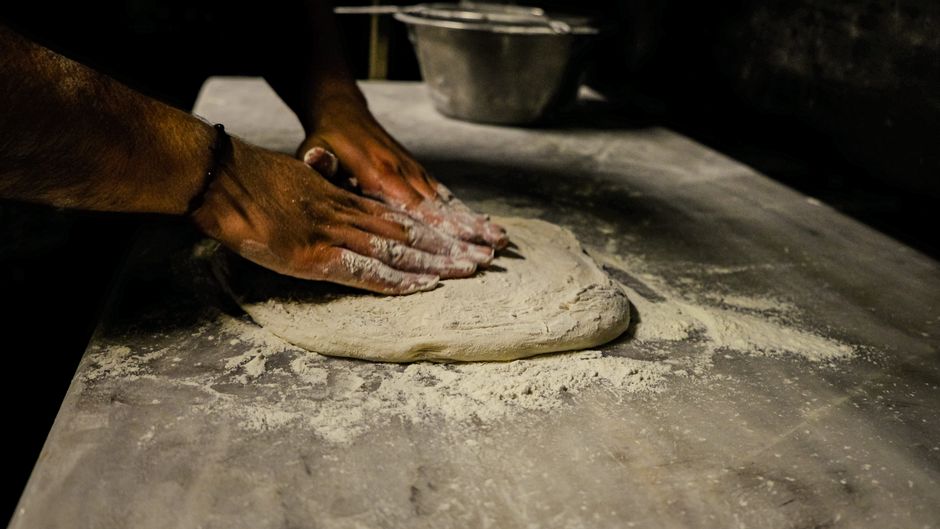
No mixer is needed for four pizzas. Bring the flour and water together in a large bowl until there are no dry patches, then leave it for ten minutes: the flour absorbs the water in that pause, and the dough is noticeably easier to knead afterwards. Add the salt, tip the dough onto an unfloured worktop and knead with the heel of your hand, pushing away and folding back, for 8 to 10 minutes.
It will feel sticky at first. Resist adding flour, which raises the effective hydration you planned and toughens the crust; a plastic scraper and slightly wet hands work better. The dough is ready when it is smooth and a gentle poke springs back slowly. You can also stretch a small piece thin: if it goes translucent before tearing (the windowpane test), the gluten is developed.
How do you shape dough balls?
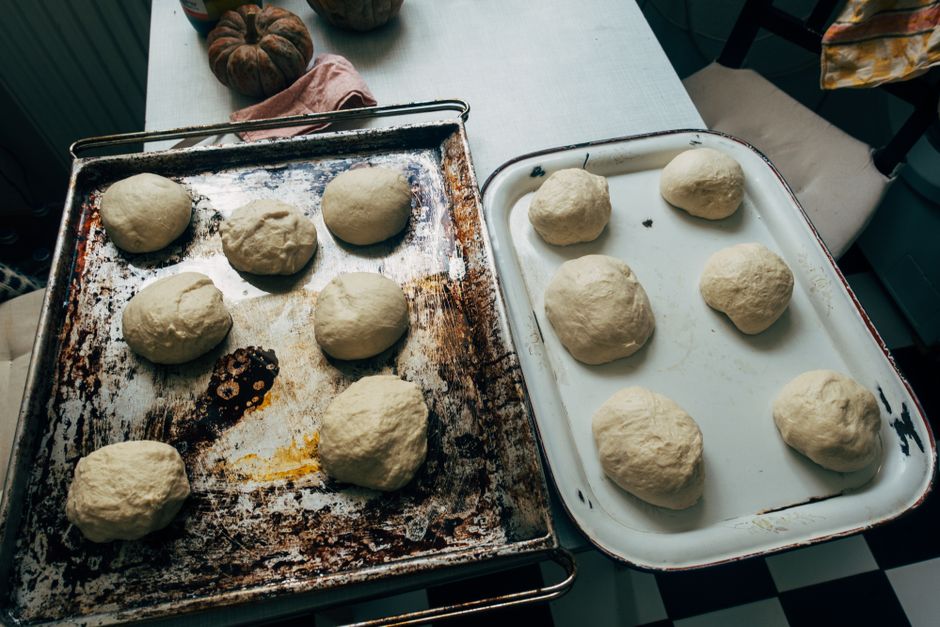
After the first hour's rest, weigh the dough into four equal pieces of about 250g, which suits the 12 to 16 inch stones most home pizza ovens use. For each one, fold the edges into the middle, flip it seam-side down and drag it towards you on the worktop with cupped hands until the surface is smooth and taut. A tight skin traps the gas and gives an even, round base later.
Store the balls apart in a lightly oiled, lidded container or individual tubs so they do not merge, and keep them sealed so the surface does not dry and crack. The cold-proofing guide covers containers and timings in more detail.
How do you stretch a base without a rolling pin?
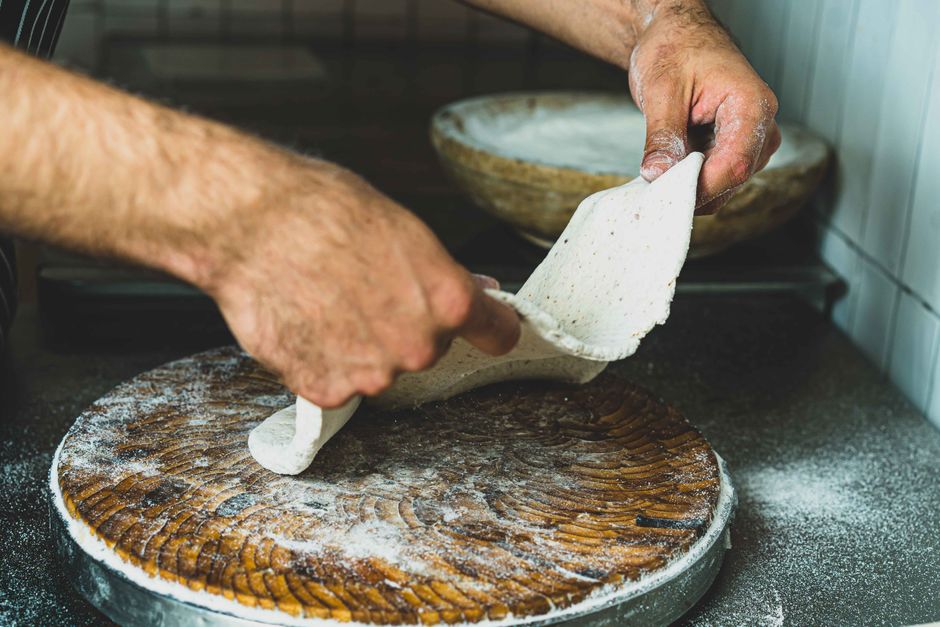
Shaping by hand is the one Naples rule worth keeping at home, because a rolling pin flattens the bubbles that make the rim puff up. Dust the ball well with flour or semolina, then press from the centre outwards with your fingertips, leaving the outer 1 to 2cm untouched to become the rim. Turn the dough as you go, then lift it over the backs of your hands and let its own weight stretch it out to about 25 to 30cm.
If it keeps springing back, it is still too cold or too tight: cover it and give it ten more minutes. If it tears, pinch the hole closed and keep the topping light over that spot. Aim for a centre thin enough to see light through when held up, with a fatter, untouched edge.
How hot should the oven be?
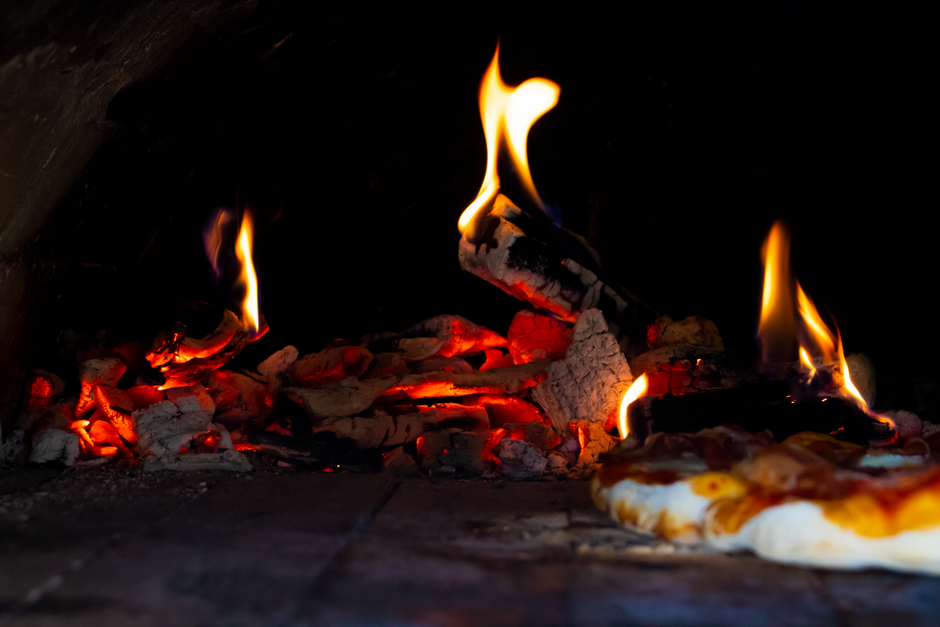
A dedicated pizza oven should have its stone at around 430 to 450C before the first pizza goes in, which bakes this dough in 60 to 90 seconds. The air temperature shown on a dial can run well ahead of the stone, so an infrared thermometer pointed at the floor is the reliable check. Turn the pizza a quarter-turn every 15 to 20 seconds so the side nearest the flame does not burn.
A kitchen oven tops out far lower, at around 250 to 280C, so the same dough bakes in several minutes and comes out crisper and less puffy. A pizza steel gets you closest. If your first bakes come out pale underneath or charred on top, the pizza oven troubleshooting guide works through the usual causes.
Adding flour while kneading
It dries the dough and toughens the crust. Use a scraper and damp hands instead.
Baking dough straight from the fridge
Cold dough tears when stretched and stays dense in the middle. Give it 1 to 2 hours out, longer in a cold kitchen.
Overloading the base
Heavy, wet toppings stop a 90-second bake cooking through. Keep them light; see the 60-second toppings guide.
Launching onto a stone that is not hot enough
The base stays pale and soft. Measure the stone, not the air.
Measuring by cups
Hydration and salt percentages only work when everything is weighed.
Frequently asked questions
What is the best flour for Neapolitan pizza?
Can I make pizza dough the same day?
How many pizzas does this recipe make?
Why is my dough hard to stretch?
Can I freeze Neapolitan pizza dough?
Should I add olive oil or sugar?
What is the difference between 00 flour and bread flour?
Cold-Proofing Pizza Dough
Pizza Dough Calculator

First Pizza Night Checklist